What a Paytable Tells You Before Play Begins
Learn how to read a paytable’s units, symbol rules and special conditions so you can tell what each listed award requires before play begins.
The common mistake with a paytable is to read its largest number as a promise about what is likely to happen. That can leave you unsure what a displayed prize actually requires. A paytable maps listed outcomes to stated awards; its entries are rules to interpret, not a forecast.
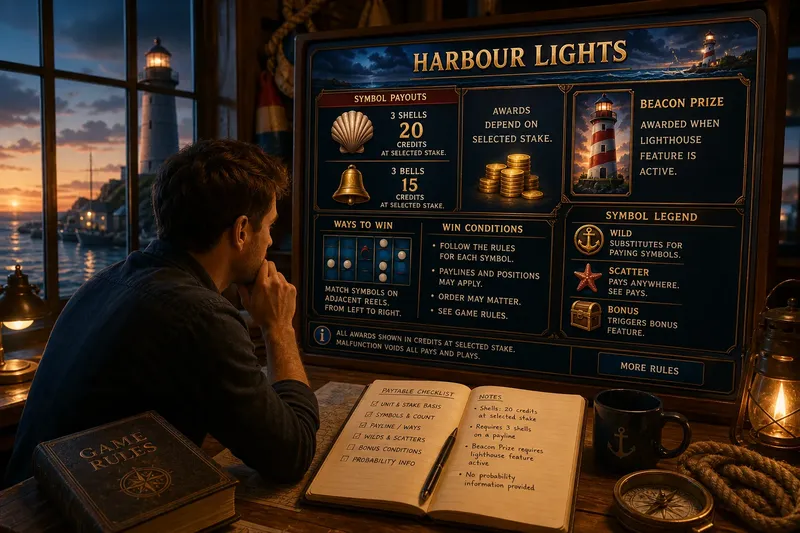
Imagine you are considering a fictional slot game called Harbour Lights. Its screen shows symbol combinations, a “ways” feature and a special prize for a lighthouse symbol. You want to understand what each entry means before deciding whether the game’s rules suit you.
Find the unit behind each payout
Start with the question, “What does this number count?” A paytable might express an award in credits, coins, a multiple of the stake, or another unit defined in the game. Without that unit, the figure is incomplete.
Say the fictional Harbour Lights paytable lists an award of 20 for three shell symbols. That invented entry could mean 20 credits, 20 times a stated bet, or something else. Check the help screen or rules for the unit and how the stake is treated; if either remains unclear, do not compare the figure with another award as though both use the same basis.
Look for the relationship between the displayed bet and the payout. Some games scale awards with the stake, while others tie them to a particular coin value or setting. Do not assume that a large-looking figure is a cash amount or applies at every stake.
Match each award to its exact symbol rule
In the invented Harbour Lights paytable, one row lists three shells and another lists three bells. Read each row as a rule for a specific result. Symbol identity, count, order and position may all matter.
Check whether symbols must land on a payline, appear anywhere in specified positions, or arrive in a particular order. A payline is a defined route across the display, so a result that looks close may not qualify. A “ways” game can use a different rule, such as matching symbols across adjacent reels; follow the game’s own explanation.
Look up the symbol legend as well. A wild may substitute for some symbols, while a scatter may pay without following a conventional line. Their effects vary by game, so an icon’s appearance or name is not enough to establish what it does.
Read special-award conditions alongside the headline
Harbour Lights also lists an invented “Beacon Prize” beside a lighthouse symbol. The name alone does not say what qualifies. Check for a required combination, bonus round, selected stake, active feature or other condition in the rules.
Note whether the displayed award is fixed or can vary under the game’s terms. If a special feature has its own screen, open it and read the explanation before deciding that the headline applies to a result you have in mind.
If an entry depends on a game label, manufacturer instructions or local rules, consult the relevant explanation rather than guessing from the display. The game interface or casino help page may clarify how that version presents its paytable and features.
Use a short check before deciding
For each entry you care about, check the observation and make the corresponding decision. If an item cannot be resolved from the display, leave it marked unclear rather than filling the gap with an assumption.
- Check whether the award names credits, coins, cash or a stake multiple; if the unit is clear, compare it on that basis, but if it is missing, do not treat the figure as a known cash amount.
- Check which stake setting the award uses; if the rules tie it to your selected setting, interpret it on that basis, but if the relationship is unclear, pause before comparing it with another payout.
- Check the required symbols and their count; if the listed combination matches the result you are considering, use that row, but if a symbol or count differs, do not assume the award applies.
- Check whether a payline, order or position is specified; if the arrangement meets that rule, continue reading the entry, but if it does not, treat the combination as unqualified.
- Check the wild and scatter legend; if it states that a symbol can substitute or pay separately, apply only that stated effect, but if no effect is given, do not infer one from the icon.
- Check the terms for a bonus or special prize; if every stated condition is met, read the listed award with those conditions, but if a condition is unmet or unclear, do not treat the headline as applicable.
- Check whether the game separately explains probability; if it provides a rule in clear terms, read that information on its own, but if it does not, do not infer frequency from the payout list.
What should you check in a paytable?
Does the number refer to credits, cash or a stake multiple?
Find the unit and the stake basis attached to the figure. If either is unclear, treat the award as not yet understood rather than converting it by guesswork.
Which exact symbol arrangement qualifies?
Check the symbols, count, order and any payline or ways rule. A similar-looking result may not meet the listed condition.
Do wilds, scatters or bonus features change the rule?
Read the symbol legend and feature description for their specific effects. Do not assume that a substitute symbol works in every combination or that a bonus label explains itself.
Does the paytable explain the chance of an outcome?
A payout row specifies an award for a qualifying result, while probability information is a separate matter. If the game does not explain probability, the payout amount and its place in the list do not supply that missing information.
Work through the fictional Harbour Lights entries
Imagine the invented Harbour Lights screen shows an award of 20 for three shells, a Beacon Prize for a lighthouse combination, and a note that awards depend on the selected stake. Treat those as fictional starting details, not real game terms. First, open the help screen and find that the shell figure is stated in credits at the selected stake; the observable result is a unit and basis you can identify.
Next, check the shell row and find that it requires three shells on a listed payline. Then open the Beacon Prize terms and find that its award requires the lighthouse feature to be active. The resulting decision is specific: the shell entry applies only to its stated line, and the Beacon Prize applies only when its feature condition is met. If either condition is absent, do not treat that award as qualifying.
Finally, inspect the screen for any separate explanation of odds. In this invented situation, none is shown, so the decision is to leave frequency unanswered rather than infer it from the prize list. You can now decide whether the rules are clear enough for you to continue, switch games or leave; if a term remains unresolved, pausing is more useful than guessing.
Use the paytable to clarify the game’s terms
A careful reading can establish the unit of an award, the exact combination that qualifies and the conditions attached to a special feature. Those details make the game’s rules easier to assess before play, even when some information is not provided.
For what a paytable tells you before play begins, focus on the entries you can verify: their units, symbol arrangements and conditions. If the rules do not explain a detail you need, treat it as unknown and make your decision accordingly.